


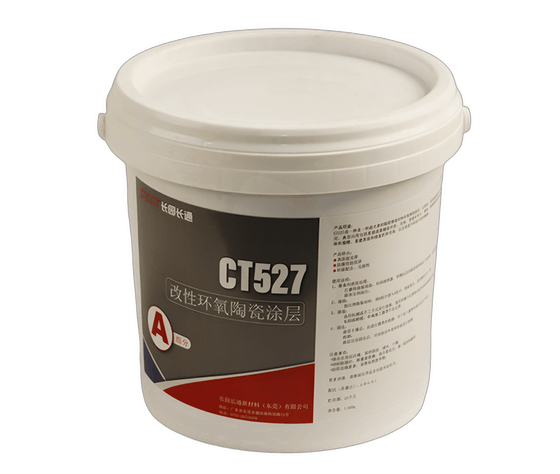
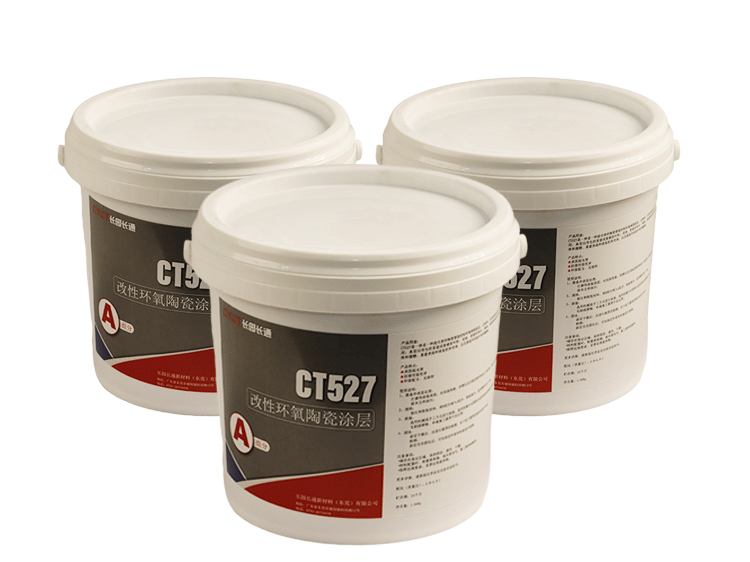
CT527 Modified Epoxy Ceramic Coating
Performance Indicators
| Glass Transition Temperature Tg, DSC (℃) | Shore Hardness | Elongation at Break(%) |
Weight Mixing Ratio
(A:B)
|
Operating Time(200g,25℃,min) |
|---|---|---|---|---|
| 51 | 85 | 2 | 4.8:1 | 35 |
| Tensile Strength(MPa) | Volume Resistivity(cm) | Adhesion(MPa) | Shear Strength(MPa) | Maximum Service Temperature(℃) |
| 27 | 2.0×10¹⁴ | 11 | 20 | 100 |
Application Areas
-
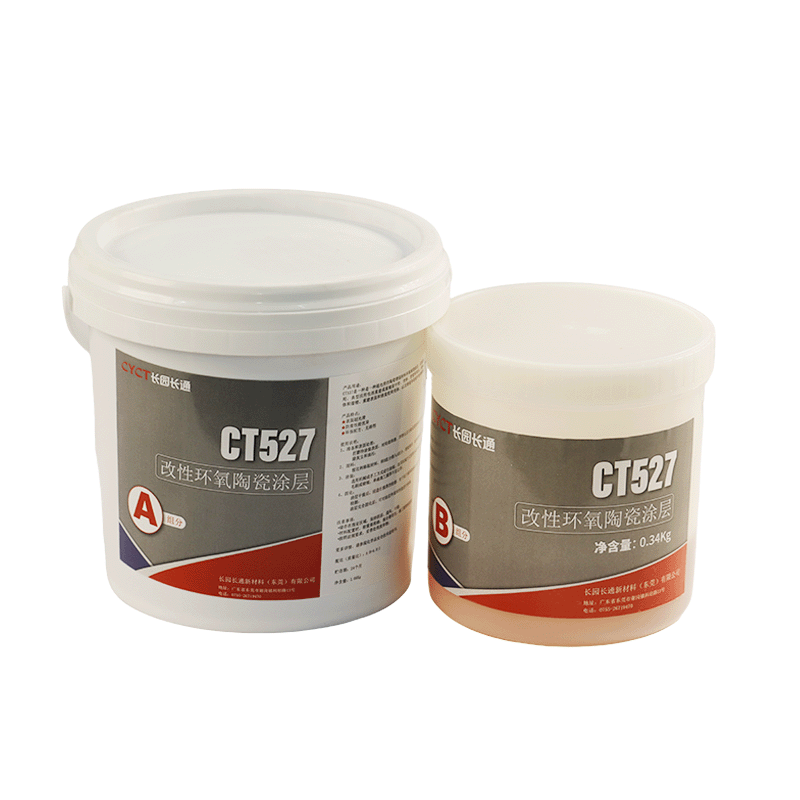 Provide smooth and wear-resistant protective coatingsIt is designed to protect surfaces from turbulent flow, chemicals, abrasives and corrosive agents. Featuring a high-gloss and low-friction surface, it can repair or improve pump efficiency. It can also be used as a topcoat for wear-resistant composites in applications requiring surface reconstruction and long-term durable protection.
 -
 Lining and surface repairLine storage tanks and chutes; resurface and repair rudders and pivot housings; restore surfaces of heat exchangers and butterfly valves; refinish condenser surfaces; repair pumps suffering from cavitation damage.
Application Method
Surface Preparation
Proper surface preparation is critical to the long-term performance of this product. Exact requirements vary based on service severity, expected service life and the initial condition of the substrate.
1. Remove contaminants such as surface dust and grease with a suitable cleaning agent; high-pressure water with flash rust inhibitor can be adopted for cleaning.
2. All sharp weld seams, welding spatter, raised beads and rough surfaces shall be ground smooth. Recesses and pinholes must be ground open and filled. All protrusions, sharp edges, high spots and corners shall be abraded to a minimum radius of 3 mm. All corners shall be rounded to maximize product performance.
3. Blast all surfaces with angular abrasive media to achieve a blast profile depth of 75–100 microns (3–4 mils), with a cleanliness standard of near-white metal (SIS SA 2½ / SSPC-SP10). For fully immersed service conditions, white metal cleanliness (SIS SA 3 / SSPC-SP 5) is mandatory.
4. After blasting, clean the metal surface with residue-free detergent or solvent to eliminate dust and contaminants. Clean, dry compressed air may also be used for dust removal. Coating shall be applied before fresh oxidation occurs on the surface.
5. If the metal has been exposed to saline solutions such as seawater, it shall be left for 24 hours after blasting and high-pressure water cleaning to allow residual salts inside the metal to leach out to the surface. Chloride contamination testing shall be performed, and the procedure repeated until the surface chloride concentration drops below 40 ppm.
Mixing
1. Weigh out resin and curing agent at a weight mixing ratio of 4.8 : 1, then mix thoroughly until a uniform color is achieved.
2. Single coat thickness: 250–500 microns (10–20 mils). A minimum of two coats is recommended to prevent pinholes. Recoating is required if two-tone separation appears.
3. Multiple coats may be applied if the target final thickness cannot be achieved in a single application. If the recoat window has expired, light blasting followed by solvent wiping is required to remove any abrasive residues.
4. Apply material onto the prepared substrate first with a thin priming coat, working the material into the texture of the base material.
5.Immediately follow with application to the required finished thickness.
Application
1. Pot life and curing rate are subject to temperature and mixed volume.
2. Higher temperatures accelerate curing.
3. Larger mixed volumes shorten curing time.
4.To accelerate epoxy curing under low-temperature conditions.
5. Store epoxy at room temperature or pre-warm resin/curing agent components before mixing. Open flame heating is strictly prohibited
6. Preheat the substrate surface until warm to the touch.
7. Maintain appropriate ambient working conditions.
8. To slow down epoxy curing under high-temperature conditions.
9. Store epoxy at room temperature or cool resin/curing agent components before mixing.
10. Carry out construction work during cool morning hours or shaded areas away from direct sunlight.
11.Perform visual inspection after application to check for pinholes or holidays.
12. Once the coating has fully cured, conduct a second visual inspection to identify pinholes, voids or damaged areas.
13.Monitor coating thickness, especially on critical sections.
14.Conduct holiday detector testing to verify coating continuity.
Precautions
1、This product is not suitable for use in pure oxygen or oxygen-enriched environments, and shall not be used as a sealing material for chlorine or other strong oxidizing substances.
2、For information on safe handling of this product, please refer to the Material Safety Data Sheet (MSDS).
3、Store at room temperature in a cool and dry place.
Shelf Life
12 months
 Name:
Name: Phone:
 Email:
 Product Options:
 Remark: