


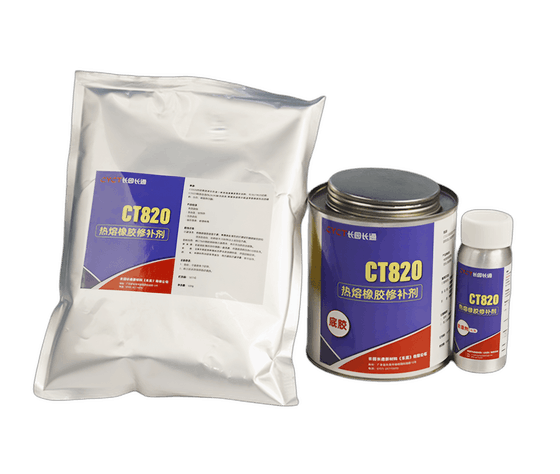
CT820 Hot‑melt Rubber Repair Agent
Performance Indicators
| Appearance & Color | Tensile Strength | Peel Strength(N/25mm) | Elongation at Break(%) | Right Angle Tear Strength(kN/m) |
Hardness
|
Operating Temperature Range(℃) |
|---|---|---|---|---|---|---|
| Black granular powdery solid | 38 | 300 | 400 | 75 |
75±5 |
-50—120 |
Application Areas
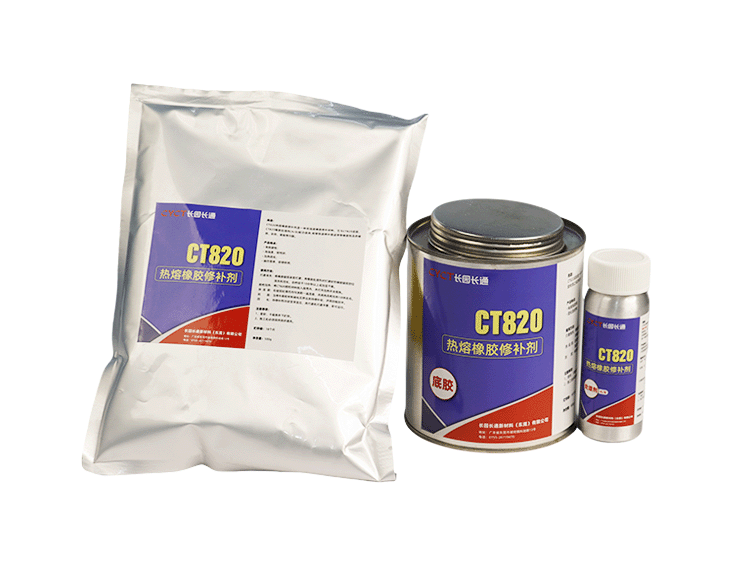
Application Method
1、Preheat the glue gun
Turn on the heating switch of the glue gun and set the temperature to 260℃. Preheat for 30 minutes, then switch on the motor to clean residual glue inside the gun automatically.
2.Buffing
Trim the damaged edges of the conveyor belt to an inclined angle of approximately 30° with a cutter. Use a tungsten carbide buffing disc to roughen the trimmed damaged rubber surface of the belt. Take care not to polish the surface or scorch the rubber during buffing.
3.Cleaning and Activation
Pour CT820 Activator B (powder) into Activator A according to the mixing ratio and stir until fully dissolved. Apply the mixture evenly onto the pretreated rubber surface for cleaning and activation, then air-dry for no less than 10 minutes (at 25℃ and 60% humidity). Extend the drying time or blow dry with a heat gun when the ambient temperature is low.
4.Primer Coating
Apply an even single coat of CT820 Primer on the fully dried rubber surface, and air-dry for at least 15 minutes (at 25℃ and 60% humidity). If the ambient temperature is low, prolong drying time or use a heat gun for blow drying.
5.Glue Spreading
Pour CT820 hot-melt pellets uniformly into the barrel of the preheated glue gun to melt them by heating. Quickly spread the molten glue extruded from the gun onto the repair area with a scraper and smooth it firmly. For large repair areas, apply the hot-melt glue from the perimeter of the damaged section toward the center.
6.Finishing
Use a heat gun to heat and smooth any uneven spots on the repaired surface. The conveyor belt can be put into operation after the repair compound cools naturally to room temperature.
Precautions
1.The hot melt glue gun must be preheated for 30 minutes in advance.
2.Before adding hot melt pellets, turn on the motor operation switch of the glue gun and run the gun to remove residual repair compound inside.
3.Adjust the feeding amount or heating temperature according to the extrusion state of the repair compound.
a. If the extruded repair compound is highly viscous and hard to spread, reduce the feeding amount.
b. If the extruded repair compound has excessively low viscosity which impairs bonding strength, turn off the heating switch temporarily.
4.Feed pellets at a constant speed to avoid clogging the feed inlet.
5.Store in a sealed and dry environment.
6.Ensure sufficient ventilation at the construction site.
Shelf Life
18 months
 Name:
Name: Phone:
 Email:
 Product Options:
 Remark: